



Consequences and clinical outcomes
The cost of malnutrition for patients and healthcare systems
Home » Healthcare Professionals » Consequences and clinical outcomes
What are the consequences of malnutrition and how may it affect your patients?
Malnutrition may be associated with a wide range of adverse clinical outcomes. When compared to those who are adequately nourished, malnourished patients can experience the following:1-9
- Poorer clinical outcomes.
- Increased mortality rates.
- More hospital visits and longer length of stay.
- Increased risk of disease.
- Impaired immune response.
- Increase in recurrent infections, including delirium, chest infection due to loss of respiratory muscle mass and function, and skin infection due to thin, friable skin.
- Increased risk of hypothermia due to reduction of insulating subcutaneous fat and impaired thermoregulation.
- Loss of skeletal muscle mass, strength, and function.
- Reduced daily functioning, loss of independence, and reduced quality of life.
- Increase in frailty, falls and fractures, due to muscle weakness, reduced coordination, and osteoporosis.
- Delayed recovery from illness and surgery.
- Impaired wound healing.
- Increased risk of the development of pressure ulcers.
- Increased risk of depression, anxiety and altered cognitive function.
- Reduction in fertility due to absence of menstrual cycles or reduced sperm count, in extreme cases.
What about the financial implication?
The significant physical and psychological burden of malnutrition as a whole upon individuals and their families also has financial implications for the wider healthcare system:3,4

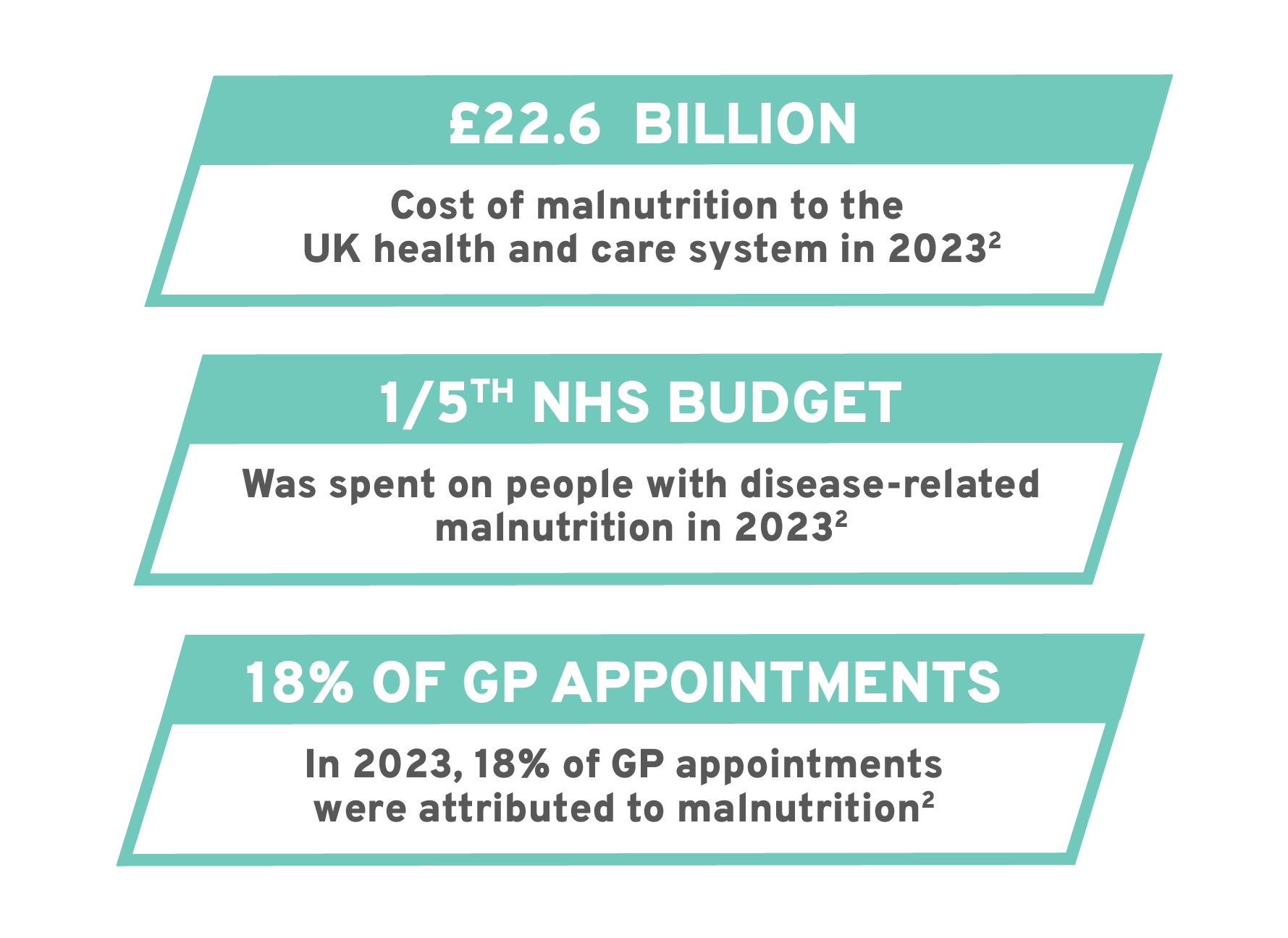
Economic analyses demonstrate that identifying and managing malnutrition as a whole is cost-effective, with the associated improvements in nutritional status and clinical outcomes leading to significant reductions in healthcare use and costs.2,3
Do you know the risk factors for malnutrition?
Learn about the physical, social and disease related causes of malnutrition.
- Adult malnutrition: what are the complications? https://cks.nice.org.uk/topics/adult-malnutrition/background-information/complications/
- BAPEN, Malnutrition in England and how failure to prevent, detect early, and effectively treat malnutrition is impacting on the NHS (2024). Available at: https://www.bapen.org.uk/wp-content/uploads/2024/09/malnutrition-submission-to-darzi-review.pdf
- Stratton R, et al. Managing malnutrition to improve lives and save money. Published on BAPEN website. Available at: https://www.bapen.org.uk/pdfs/reports/mag/managing-malnutrition.pdf
- Holdoway A, et al (consensus panel). Managing Adult Malnutrition in the Community. 3rd edition, 2021. Available at: malnutritionpathway.co.uk/library/managing_malnutrition.pdf
- Meyer F and Valentini L. Visc Med. 2019;35(5): 282-291.
- Xie L, et al. J Am Med Dir Assoc. 2022;23(5): 722-728.
- Venianaki M, et al. J Clin Med. 2021;10: 2550.
- Calder, PC. Nutr Diabetes. 2021;11: 19.
- Rasheed S and Woods RT. Ageing Res Rev. 2013;12: 561-566.
Adverse events should be reported. Reporting forms and information can be found at yellowcard.mhra.gov.uk or by searching for MHRA Yellow Card in the Google Play or Apple App Store. Adverse events should also be reported to Pharmacovigilance at Alliance Pharmaceuticals Ltd, Tel: 01249 466966, email: pharmacovigilance@alliancepharma.co.uk.