Malnutrition prevalence
The scale of malnutrition within the UK
Home » Healthcare Professionals » Malnutrition prevalence
How prevalent is malnutrition in the UK?
Individuals diagnosed with malnutrition, or at risk, are often unrecognised. In 2024 it was estimated around 3 million people in the UK might be at risk or affected.1
Risk of malnutrition is common across healthcare settings, affecting people in social care settings, secondary care and in their own homes.1,2
Malnutrition (undernutrition) affects:
- 35% of people recently admitted to care homes1
- 29% of adults admitted to hospital1
- 30% attending hospital outpatients1
- 11% of of people at GP practices.1
Did you know that nearly half of all adults are at risk of disease related malnutrition?
Disease related malnutrition is a poorly recognised and poorly managed form of malnutrition defined as “a condition from the lack of intake or utilisation of nutrients during any disease state, resulting in weight loss, loss of skeletal muscle, physical and mental dysfunctions, and worse clinical outcome.”3,4 This form of malnutrition is driven by inflammatory processes, as well as the reduced food intake and assimilation commonly associated with disease presence.4
The most recent estimates indicate 48% of adults across community and hospital settings in the UK in 2023 were at risk of disease-related malnutrition, an increase from 42% in 2019.2
The 2023 Malnutrition and Nutritional Care Survey evaluated malnutrition prevalence using the Malnutrition Universal Screening Tool (‘MUST’) to categorise patients into low, medium or high risk for malnutrition.2
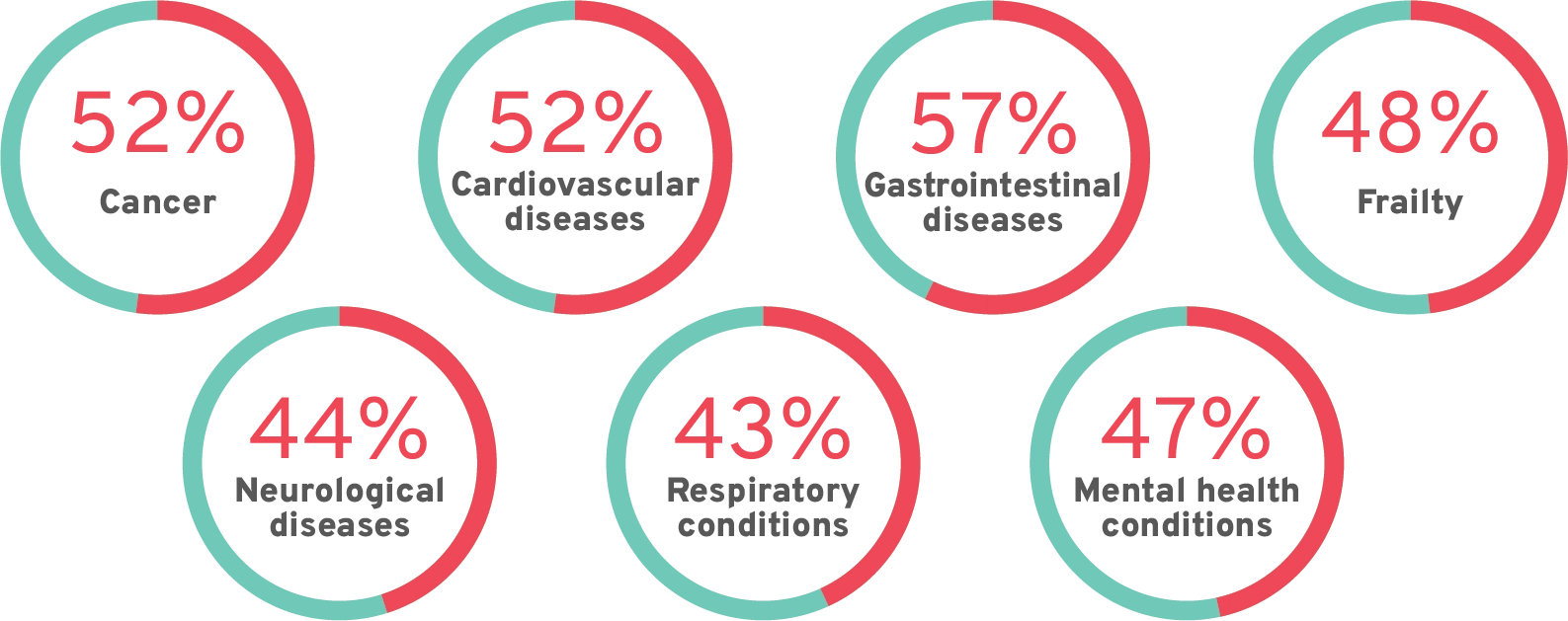
The prevalence of malnutrition risk (medium and high) according to primary diagnosis:2
(n=2250, BAPEN 2023, UK)
Will malnutrition become more common in the future?
Malnutrition prevalence is expected to increase due to the UK’s ageing population.5 An ageing UK population will result in an increase in those living with chronic diseases, multimorbidity and age-related changes.5-7
Current estimates suggest that around one in 10 older adults (65 years and older) are malnourished or at risk of malnutrition. This number is expected to rise alongside the forecasted rapid increase in the ageing population, with a projected increase of 4.75 million, equating to an almost 50% increase in the number of people aged over 65 years from 2015 to 2035.7
What about micronutrients?
Learn about why micronutrients matter when it comes to malnutrition.
- Adult malnutrition: How common is it? NICE CKS. Available at: https://cks.nice.org.uk/topics/adult-malnutrition/background-information/prevalence/
- British Association for Parenteral and Enteral Nutrition (BAPEN). Malnutrition and Nutritional Care Survey in Adults. Report by the Malnutrition Action Group Chair and Committee of 2023. 2024. Available at: https://www.bapen.org.uk/reports/malnutrition/malnutrition-and-nutritional-care-survey-in-adults-2023/
- Disease related malnutrition (DRM) The European Society for Clinical Nutrition and Metabolism (ESPEN) Fact Sheet. Available at: http://www.espen.org/images/files/ESPEN-Fact-Sheets/ESPEN-Fact-Sheet-Disease-Related-Malnutrition-DRM.pdf
- World Health Organization. Disease-related malnutrition: a time for action. Available at: iris.who.int/bitstream/handle/10665/375033/WHO-EURO-2023-8931-48703-72392-eng.pdf?sequence=5&isAllowed=y
- Living longer: how our population is changing and why it matters. Office For National Statistics. Available at: https://www.ons.gov.uk/peoplepopulationandcommunity/birthsdeathsandmarriages/ageing/articles/livinglongerhowourpopulationischangingandwhyitmatters/2018-08-13
- Bardon LA, et al. Ageing rate of older adults affects the factors associated with, and the determinants of malnutrition in the community: a systematic review and narrative synthesis. BMC Geriatrics 2021; 21:676 https://doi.org/10.1186/s12877-021-02583-2
- State of the Nation 2021: Older people and malnutrition in the UK today. The Malnutrition Task Force. Available at: https://www.malnutritiontaskforce.org.uk/sites/default/files/2021-10/State%20of%20the%20Nation%202020%20F%20revise.pdf
Adverse events should be reported. Reporting forms and information can be found at yellowcard.mhra.gov.uk or by searching for MHRA Yellow Card in the Google Play or Apple App Store. Adverse events should also be reported to Pharmacovigilance at Alliance Pharmaceuticals Ltd, Tel: 01249 466966, email: pharmacovigilance@alliancepharma.co.uk.